
F-35 Program: DOD Needs to Strengthen Oversight of Tens of Billions of Dollars in Parts
Fast Facts
DOD's F-35 aircraft program is the costliest in its history—its 26 million aircraft parts alone are worth around $31 billion.
But we found that DOD struggles to account for these parts. For example, DOD’s records of its F-35 parts are outdated, inaccurate, and incomplete. And the F-35 program neither records all these parts during its physical inventories nor monitors losses of these parts.
One reason for these issues is that DOD doesn’t provide adequate training and procedures for staff tasked with accounting for these parts.
We recommended that DOD address these issues.
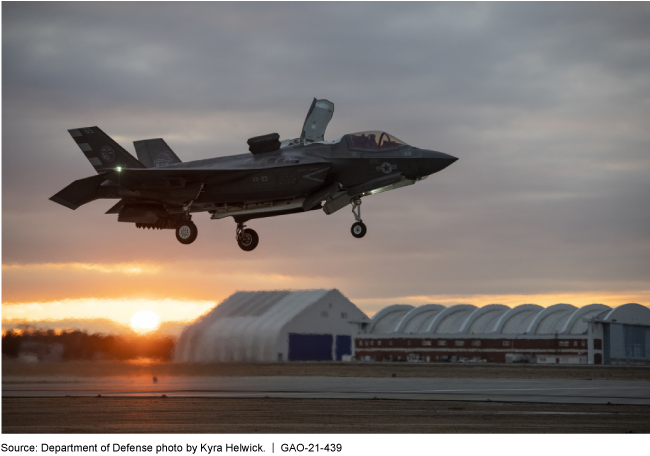
An F-35 landing.
Highlights
What GAO Found
The Department of Defense (DOD) continues to face challenges in accounting for F-35 parts, such as engines and tires. The F-35 program includes approximately 26 million F-35 parts, valued at approximately $31 billion and held at over 700 contractor- and government-managed facilities around the world. Although these are DOD-owned parts, DOD does not maintain complete records of the parts.
Specifically, GAO found that DOD has not established procedures that ensure its own records will be sufficient to account for and financially report on the parts (see figure). For instance, records of F-35 parts in the F-35 program’s accountable property system of record (APSR) remain unreliable, since they do not reflect real-time changes and are inaccurate and incomplete. Also, the F-35 Joint Program Office (JPO) has not fully developed procedures to validate the accuracy of data it enters into the APSR. GAO has an open recommendation addressing this issue (GAO-22-105002). GAO also found that F-35 JPO’s physical inventory procedures did not adequately verify the existence and validate the completeness of F-35 parts. Without accurate data in its APSR and properly executed inventory procedures for F-35 parts, DOD management will not have the information it needs to support warfighter readiness and reliable financial reporting.
Further, as of March 2026, F-35 JPO did not know the status of lost F-35 parts valued at over $85 million that GAO reported on in 2023. Also, F-35 JPO has not established procedures for effectively reviewing losses reported at government-managed facilities. Unless it implements procedures for monitoring losses, F-35 JPO will not know the full extent of losses of F-35 parts, and its ability to mitigate losses in the future will be decreased, reducing its ability to detect fraud, waste, or theft.
Records of F-35 Parts Are Not Reliable for Asset Accountability or Financial Reporting
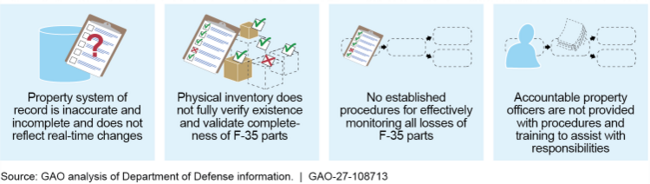
F-35 JPO has not established a mature, fully functioning property accountability program that would provide its accountable property officers with program-specific procedures and training to help them carry out their responsibilities. This limits the effectiveness of F-35 JPO’s oversight of asset accountability for F-35 parts, which, combined with the issues identified above, will affect warfighter readiness. Also, DOD is taking steps toward including F-35 parts on its financial statements, such as developing procedures to value parts with missing cost information. These procedures and others are under review.
Why GAO Did This Study
The F-35 aircraft is DOD’s most costly weapon system in history, with overall costs for the F-35 program estimated to be more than $1.9 trillion over its life cycle. However, as GAO and DOD auditors have previously reported, DOD has long-standing and ongoing deficiencies related to the accountability and financial reporting of F-35 parts.
Title 31 of the U.S. Code includes a provision in statute for GAO to audit the U.S. government’s consolidated financial statements. This report, developed in connection with fulfilling that mandate, examines the extent to which DOD has (1) established and implemented procedures to account for F-35 parts and (2) made progress in including these parts on its agencywide financial statements.
GAO reviewed, among other things, relevant reports, accounting standards, supporting documentation, and DOD policies and procedures. GAO also interviewed DOD officials and conducted site visits.
Recommendations
GAO is making four recommendations, including for DOD to develop, document, and implement F-35 program-specific procedures for monitoring losses of F-35 parts and procedures and training for accountable property officers to carry out their responsibilities. DOD concurred with all four recommendations and cited actions it is taking to address them.
Recommendations for Executive Action
| Agency Affected | Recommendation | Status |
|---|---|---|
| Department of Defense | The Secretary of Defense should ensure that the Office of the Under Secretary of Defense for Acquisition and Sustainment, in conjunction with the F-35 Program Executive Officer and the Defense Contract Management Agency, develops, documents, and implements procedures for monitoring submission of loss information of F-35 parts, including procedures for performing trend analyses that would enable mitigation of future losses. (Recommendation 1) |
When we confirm what actions the agency has taken in response to this recommendation, we will provide updated information.
|
| Department of Defense | The Secretary of Defense should ensure that the Under Secretary of Defense for Acquisition and Sustainment, in conjunction with the F-35 Program Executive Officer, develops, documents, and implements F-35 program-specific procedures for APOs to carry out their responsibilities. (Recommendation 2) |
When we confirm what actions the agency has taken in response to this recommendation, we will provide updated information.
|
| Department of Defense | The Secretary of Defense should ensure that the Under Secretary of Defense for Acquisition and Sustainment, in conjunction with the F-35 Program Executive Officer, develops, documents, and implements F-35 program-specific training for APOs to carry out their responsibilities. (Recommendation 3) |
When we confirm what actions the agency has taken in response to this recommendation, we will provide updated information.
|
| Department of Defense | The Secretary of Defense should ensure that the Under Secretary of Defense for Acquisition and Sustainment, in conjunction with the F-35 Program Executive Officer, clarifies and documents the structure of the F-35 APO program, including determining the number of APOs needed, their locations, and the time commitment necessary to perform APO duties. (Recommendation 4) |
When we confirm what actions the agency has taken in response to this recommendation, we will provide updated information.
|