
Immigration Detention: ICE Should Determine Cost Effectiveness of New Initiatives Before Continuing
Fast Facts
In July 2025, U.S. Immigration and Customs Enforcement got $45 billion for detention facilities.
ICE used some of this funding to operate existing facilities and purchase 11 new warehouses. We previously reported that ICE rapidly implemented this warehouse initiative before scaling it down, likely leading to waste.
Our new report found that ICE has neither determined the scope and costs to purchase more facilities nor updated its spending plan to reflect its current efforts. ICE also hasn’t assessed the cost effectiveness of these investments.
Our recommendations address these issues.

ICE logo with an American flag in the background.
Highlights
What GAO Found
Within the Department of Homeland Security (DHS), U.S. Immigration and Customs Enforcement (ICE) received $45 billion in immigration detention funding in July 2025 through Public Law 119-21, commonly known as the One Big Beautiful Bill Act, available through fiscal year 2029. In addition to maintaining existing facilities with these funds, ICE began implementing an initiative to buy and renovate a collection of warehouses to use as new detention facilities. However, after acquiring 11 warehouses for about $1.07 billion, ICE scaled down the initiative significantly and plans to sell seven of them. In July and August 2026, ICE also bought four existing detention facilities for about $2.2 billion total. However, the scope, time frames, and estimated costs for further acquisitions remain undetermined. In addition, ICE did not update its spending plan for detention funding to reflect the shifting status of the warehouse initiative or other planned acquisitions, as required by its internal guidance. As a result, the spending plan includes an inflated estimate of planned obligations, which affects oversight efforts and ICE’s ability to assess long-term budget needs.
Examples of U.S. Immigration and Customs Enforcement Warehouse Facilities
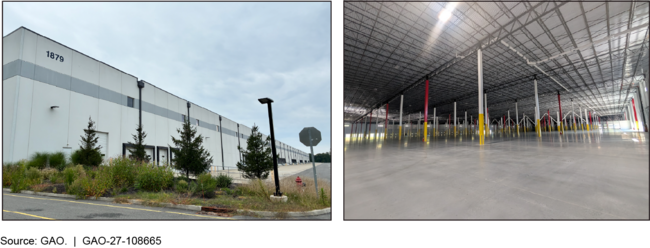
ICE obligated about $2.8 billion for detention in fiscal year 2025, an increase of about 41 percent from the prior year, amid expanded enforcement activity. Daily costs per detained noncitizen varied by facility type. The nine Federal Bureau of Prisons facilities ICE used charged a median daily rate of $180 per noncitizen, the highest of any facility type. Privately operated facilities had a median rate of $151, while those operated through agreements with the U.S. Marshals Service or state and local governments ranged from $85 to $103. ICE officials said that services provided, detention standards used, and location also influence rates.
ICE employs various processes to manage and oversee facility costs, but some were affected by the rapid expansion of new facilities. For example, the workload of staff who provide oversight and validate invoices for these facilities increased significantly, and ICE is working to fill 55 of the 87 allocated positions nationwide. Further, ICE did not manage detention facility investments in accordance with DHS acquisition practices, which include the development of life-cycle cost estimates. Developing such estimates before making further acquisitions would position ICE to better assess these investments, reduce potential waste, and help ensure the cost effective use of taxpayer dollars.
Why GAO Did This Study
A January 2025 Executive Order directed DHS to increase efforts to detain individuals apprehended for violations of immigration law and to allocate all available resources for ICE detention. ICE received significant funding in July 2025 to operate and expand detention facilities.
GAO was asked to review the costs of ICE’s detention facilities. This report examines (1) the extent to which ICE has planned to use available funds to expand detention capacity; (2) the costs of detention facilities over time and by facility type; and (3) the extent to which ICE has developed processes and procedures for managing and overseeing these costs.
GAO reviewed documentation on detention expansion efforts, agency spending plans, and facility costs from October 2022 through various points in 2026. GAO interviewed headquarters and field officials at four ICE field offices, including site visits to multiple existing and planned detention facilities. GAO selected these locations, in part, because they were the sites of multiple detention expansion efforts. GAO reviewed available cost estimates and compared spending plans to ICE guidance. GAO also analyzed information on the Department of Defense’s and Federal Emergency Management Agency’s costs for supporting immigration detention.
Recommendations
GAO is making two recommendations, that ICE update its spending plan for detention funding in accordance with internal guidance, and develop life-cycle cost estimates, in coordination with DHS, before making new detention investments. DHS concurred with these recommendations.
Recommendations for Executive Action
| Agency Affected | Recommendation | Status |
|---|---|---|
| United States Immigration and Customs Enforcement | The Director of ICE should ensure that agency spending plans for ICE detention funds, including those received through the reconciliation process, are updated in a timely manner in accordance with ICE policy and include all required elements. (Recommendation 1) |
When we confirm what actions the agency has taken in response to this recommendation, we will provide updated information.
|
| United States Immigration and Customs Enforcement | The Director of ICE, in coordination with the DHS Undersecretary for Management, should develop life-cycle cost estimates and evaluate alternatives to inform any significant future detention facility investments. (Recommendation 2) |
When we confirm what actions the agency has taken in response to this recommendation, we will provide updated information.
|