
Federal Social Safety Net Programs: Millions of Workers, Including Many Employed by Large Employers, Continue to Rely on Medicaid and SNAP [Reissued with revisions on Aug. 24, 2026]
Fast Facts
Millions of American adults earn so little that they rely on federal programs to make ends meet, such as Medicaid and the Supplemental Nutrition Assistance Program.
To learn more about the working adults who used these programs in 2024, we analyzed employment data from 11 states and Census data.
We found:
- About two-thirds worked full time
- Most worked for private sector employers
- Workers were largely in transportation, restaurants and food prep, and retail sales jobs
- Some employers in selected states had thousands of beneficiaries on their payrolls

Currency on tax documents
Reissued with Revisions Aug 24, 2026Revised on August 24, 2026, to correct table 6 on page 9 (specifically, the number of nondisabled, nonelderly (NDNE) working adult Medicaid enrollees in Rhode Island and the corresponding percentages of NDNE working adult enrollees as a percentage of total Medicaid enrollees and all adult Medicaid enrollees) and table 22 on page 26 (specifically, the number of nondisabled, nonelderly (NDNE) working adult Medicaid enrollees in Rhode Island).
Highlights
What GAO Found
According to U.S. Census Bureau data, an estimated 13.8 million adults enrolled in Medicaid and 10.6 million adults living in households that received Supplemental Nutrition Assistance Program (SNAP) benefits worked at some point during 2024. This is out of approximately 28 million and 20 million adults ages 19–64 in these programs, respectively. GAO’s analysis of Census data showed that about two-thirds of these adults in each program worked full-time (35 hours or more a week). However, when compared to other wage-earning adults not participating in either program, wage-earning adult Medicaid enrollees and SNAP recipients were less likely to work full-time hours for 50 or more weeks per year.
Estimated Percentage of Wage-Earning Adults Working Full-Time and Part-Time Work Schedules in 2024
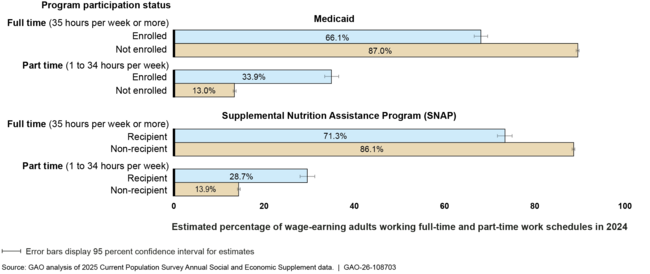
Most of these wage-earning adults in both programs (88 percent) were employed in the private sector in 2024, which is higher than the percentage of wage-earning adults in the private sector who were not enrolled or not receiving benefits. Wage-earning adult Medicaid enrollees and SNAP recipients were also more likely than wage earners who did not participate in the programs to work in food service and food preparation occupations.
According to GAO’s analysis of state-level data for September 2025, the employers with the most nondisabled, nonelderly Medicaid enrollees or SNAP beneficiaries varied across the 11 states that provided data. However, 46 companies (about one-third of the total companies across all 11 states) were among the top 25 employers of Medicaid enrollees or SNAP beneficiaries in at least two states. Seventeen of these 46 companies were among the 50 largest Fortune 500 companies by number of employees.
Why GAO Did This Study
Each year millions of wage-earning adults participate in federally funded social safety net programs to help pay for basic needs including health care and food assistance. GAO was asked to update information provided on wage-earning Medicaid enrollees and SNAP recipients in its October 2020 report (GAO-21-45).
This report includes an analysis estimating (1) the labor characteristics of working adult Medicaid enrollees and SNAP recipients and (2) employers of adult Medicaid enrollees and SNAP recipients in selected states.
To conduct this work, GAO analyzed recent Census data on the labor characteristics of wage-earning adults in the two programs. GAO also analyzed data on the employers of nondisabled, nonelderly working adult Medicaid enrollees and working adult SNAP recipients obtained from 15 state agencies across 11 states as of September 2025.
For more information, contact Kathryn Larin at larink@gao.gov.