
Critical Minerals: Reducing U.S. Import Reliance with Substitution and Recycling Technologies
Fast Facts
The U.S. relies on imports for many critical minerals that are essential to the battery and semiconductor industries. But their supply chains are vulnerable to disruptions.
We looked at how substitution and recycling technologies might reduce reliance on imports. Battery recycling—extracting minerals from batteries for reuse—could reduce imports in 2 to 3 years. Policy options that could help reach this goal include establishing infrastructure for collecting and recycling materials.
By contrast, substitution and recycling may not reduce short-term import reliance in the semiconductor industry.
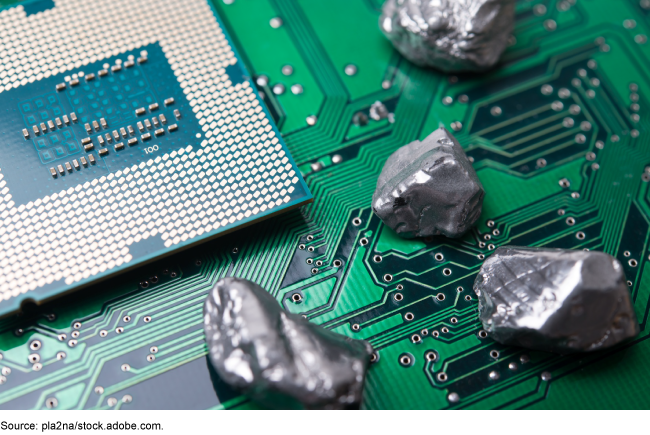
An electronic chip with small rock-like items on it.
Highlights
What GAO Found
Technologies like batteries and semiconductors are essential to the U.S. economy but rely on imports of lithium, gallium, and other critical minerals. GAO found that substitution and recycling technologies could help reduce U.S. reliance on these imports. But progress is likely to take many years in some cases.
Potential for technologies to reduce critical mineral import reliance
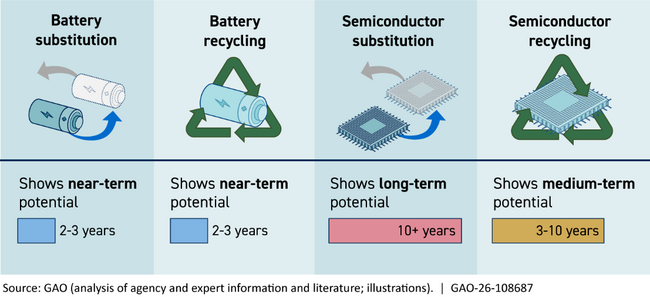
For batteries, substitution and recycling technologies offer near-term potential. For example, using lithium iron phosphate batteries for stationary grid energy storage might reduce imports of cobalt, manganese, and nickel in the next 2 to 3 years. But these batteries do not perform as well in other applications, like long-haul electric vehicles, due to their lower energy density. Lithium-free batteries are not yet commercially mature. Battery recycling technologies are mature and offer a pathway to reduce imports for copper, cobalt, lithium, and nickel in 2 to 3 years. These technologies aim to recover critical minerals at high rates through chemical leaching and smelting. Experts told GAO, however, that U.S. battery recyclers lack capacity. Additionally, available inputs for recycling (referred to as feedstock) are often landfilled or exported for processing.
For semiconductors, most substitution and recycling technologies are likely years away from maturity. Substitution is unlikely to have a near-term effect on import reliance of minerals, such as gallium and indium, because other materials do not perform as well as these critical minerals across the same conditions. Experts told GAO that industry will not adopt substitutes until they can perform at the same level as current semiconductor materials in the intended application. Technologies to recycle minerals from semiconductors also face challenges, such as an underdeveloped market. Semiconductor manufacturing scrap is a potential source of recycled minerals, though this is not yet standard practice in the U.S. Discarded electronics are another potentially large source, but their critical mineral content is low, and those minerals are generally mixed and bonded with other materials. Technologies to recycle this form of electronic waste are in pilot-stage development.
GAO identified four policy options that could support the goal of reducing critical mineral import reliance and help address challenges to recycling and substitution technologies. These options identify possible actions by policymakers, which include legislative bodies, government agencies (federal, state, and local), academia, standards-setting organizations, industry, and other groups. In general, these technologies have potential, with policy action, to reduce some of this reliance in the near, medium, or long term. See below for details on these options.
Policymakers could also choose to pursue non-technological policy approaches, such as increased domestic mining. Many non-technological approaches are the subject of current and proposed legislation and executive action (see report p. 6).
Policy options to support reducing critical mineral import reliance and address challenges to substitution and recycling technologies
|
Establish domestic manufacturing capacity for viable substitutes (report p. 23) Policymakers could consider building or repurposing existing manufacturing capacity to produce substitute technologies for batteries and semiconductors. |
|
|---|---|
|
Potential implementation approaches
|
Opportunities and Considerations
|
|
Establish domestic recycling capacity (report p. 24) Policymakers could build domestic infrastructure to bolster the domestic capacity to recycle batteries and semiconductors. |
|
|
Potential implementation approaches
|
Opportunities and Considerations
|
|
Secure inputs for recycling (report p. 24) Policymakers could support efforts to collect, sort, transport, and store manufacturing scrap and end-of-life devices for recycling and reuse. |
|
|
Potential implementation approaches
|
Opportunities and Considerations
|
|
Support research, development, and testing (report p. 25) Policymakers could continue or grow support for research, development, and testing of substitution and recycling technologies. |
|
|
Potential implementation approaches
|
Opportunities and Considerations
|
Source: GAO. | GAO-26-108687
Why GAO Did This Study
The U.S. considers 60 minerals as critical because they are essential to the nation’s economy or security and have supply chains vulnerable to disruption.
Several critical minerals are key to the functioning of batteries and semiconductors, which have applications in electric vehicles, stationary grid energy storage, consumer electronics, and the defense industry. For example, lithium is a key component of modern batteries that are both lightweight and energy-dense. Semiconductors rely on the unique electrical properties of critical minerals such as gallium, germanium, arsenic, and indium.
U.S. executive and legislative branch policymakers have a long-standing goal to reduce critical mineral import reliance, through technological innovations and other approaches.
This report examines: (1) substitution and recycling technologies to reduce import reliance on critical minerals within the battery and semiconductor industries, (2) challenges to the development and adoption of these technologies, and (3) policy options to support reducing reliance.
To conduct this technology assessment, GAO interviewed federal officials and experts and reviewed academic papers, agency and expert documentation, and federal policy. GAO identified four policy options in this report (see next page).
For more information, contact Sarah Harvey at HarveyS@gao.gov.