
Domestic Terrorism: Additional Actions Needed to Implement an Effective National Strategy
Fast Facts
Domestic terrorism threats have increased in recent years. In 2021, the White House issued the National Strategy for Countering Domestic Terrorism, which tasked multiple federal agencies with actions to address these threats. Agencies have taken steps to implement 49 of the 58 activities we identified.
We found ways the strategy could be more effective. For example, it doesn't clarify which federal agency is responsible for overseeing the effort. It also doesn't specify time frames and costs needed to carry out activities or specify how agencies should show they're making progress.
We recommended that the strategy include this information.
Highlights
What GAO Found
The 2021 National Strategy for Countering Domestic Terrorism (Strategy) tasked the Departments of Homeland Security (DHS) and Justice (DOJ), the Federal Bureau of Investigation (FBI), and other federal agencies to implement activities to counter domestic terrorism. Agencies have taken steps to implement most of these activities (49 of 58 activities identified by GAO) through both new and preexisting efforts. For example, agencies shared online resources for terrorism prevention with nonfederal partners and the public and updated screening procedures for federal and military personnel. The Strategy also states that nonfederal partners, such as state and local entities, play a role in countering domestic terrorism.
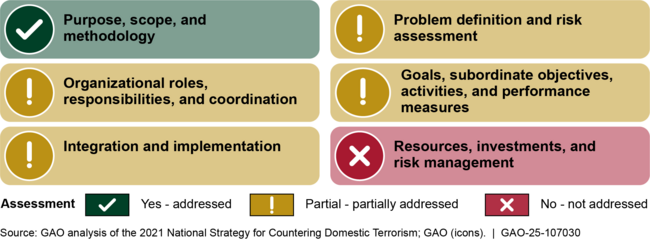
The Strategy, however, does not fully address most of the six desirable characteristics that GAO has previously reported comprise an effective national strategy. For example, the Strategy does not include a risk assessment or clarify which federal entity is responsible for oversight. Further, it does not consistently include milestones, performance measures, or resource information. By including such information in the Strategy, or any national strategy, in effect, to combat domestic terrorism, the National Security Council (NSC) could improve how it oversees activities. In turn, this could enable the NSC and relevant agencies to measure progress in meeting goals to successfully address domestic terrorism and enhance public safety.
Extent to Which the 2021 National Strategy for Countering Domestic Terrorism Addresses GAO's Desirable Characteristics of an Effective National Strategy
Federal and nonfederal partners identified challenges related to the Strategy, such as not knowing which agencies were responsible for specific activities. DHS and DOJ, two agencies with statutory missions to combat domestic terrorism and tasked with the most Strategy activities, have shared some details about Strategy implementation, such as providing domestic terrorism-related information on publicly accessible websites. However, they could further clarify their roles and efforts to counter domestic terrorism and communicate such to nonfederal partners to ensure their contributions effectively assist federal efforts. In doing so, DHS and DOJ would be better equipped to address their missions related to countering domestic terrorism. Also, nonfederal partners could better align their resources to support federal efforts.
Why GAO Did This Study
In June 2021, the White House NSC released a Strategy that aims to provide a framework to address domestic terrorism, which it identified as an urgent priority. The FBI Director testified in December 2023 that domestic terrorism investigations had more than doubled since 2020.
GAO was asked to review the Strategy. This report examines, among other things, (1) steps agencies have taken to implement the Strategy, (2) the extent to which the Strategy includes desirable characteristics for an effective national strategy, and (3) challenges identified by federal and nonfederal partners in implementing the Strategy.
GAO reviewed the Strategy and related documents, analyzed NSC information, and interviewed officials from eight federal agencies. GAO also interviewed nonfederal partners and Joint Terrorism Task Force personnel in seven geographically dispersed states that had experience with domestic terrorism incidents, as well as 12 domestic terrorism experts.
Recommendations
GAO recommends that the NSC ensure any domestic terrorism strategy reflects all desirable characteristics and that DHS and DOJ inform nonfederal partners about roles to combat domestic terrorism. In response to comments, GAO modified the recommendations to apply them to any national domestic terrorism strategy as well as DOJ and DHS's broader missions. NSC did not provide comment and DOJ concurred. DHS did not concur but will work with nonfederal partners to counter domestic terrorism.
Recommendations for Executive Action
| Agency Affected | Recommendation | Status |
|---|---|---|
| National Security Council | The Chairperson of the NSC or their designee should work with relevant federal entities to ensure any strategy, in effect, and related documents guiding the nation's efforts to counter domestic terrorism reflect desirable characteristics of an effective national strategy, including
|
The National Security Council did not provide any comments on the draft report. In September 2025, the administration signed a National Security Presidential Memorandum (NSPM)-7 establishing a strategy to investigate, disrupt, and dismantle all stages of organized political violence and domestic terrorism. NSPM-7 directs the Federal Bureau of Investigation's Joint Terrorism Task Force (JTTFs) to coordinate this national strategy to investigate, prosecute, and disrupt entities and individuals engaged in political violence and intimidation designed to suppress lawful activity or obstruct the rule of law. NSPM-7 also designates domestic terrorism as a national priority area. We will continue to monitor implementation of NSPM-7.
|
| Department of Homeland Security | The Secretary of Homeland Security, in coordination with the Attorney General, should help further clarify its roles and efforts to counter domestic terrorism and communicate those roles to nonfederal partners to ensure their contributions effectively assist federal efforts, including those related to any national strategy, in effect, to combat domestic terrorism, as appropriate. (Recommendation 2) |
The Department of Homeland Security (DHS) did not concur with this recommendation. In April 2025, DHS noted that the National Security Council was in the process of developing a new counterterrorism strategy and that the 2021 Strategy would be rescinded. As a result, DHS requested that the recommendation be closed. While we acknowledged that policy changes are likely in a new administration, including adopting new national strategies, we maintain that it is important that DHS coordinate with the Attorney General to help further clarify its roles and responsibilities to counter domestic terrorism to nonfederal partners. In September 2025, the administration issued National Security Presidential Memorandum (NSPM-7), which is directed at countering domestic terrorism and organized political violence. Among other things, NSPM-7 requires the development of a new comprehensive national strategy to counter political violence and intimidation. We consider this recommendation open and valid and we will continue to monitor DHS efforts, including as they related to any new national strategy.
|
| Department of Justice | The Attorney General, in coordination with the Director of the FBI and the Secretary of Homeland Security, should help further clarify its roles and efforts to counter domestic terrorism and communicate those roles to nonfederal partners to ensure their contributions effectively assist federal efforts, including those related to any national strategy, in effect, to combat domestic terrorism. (Recommendation 3) |
In April 2025, the Department of Justice's audit liaison provided an email stating that DOJ concurred with our recommendation. In December 2025, DOJ officials stated that the FBI regularly communicates with nonfederal partners on its own and in concert with the Department of Homeland Security (DHS). However, DOJ did not provide details on actions related to implementing this recommendation. Therefore, the recommendation will remain open and we will continue to monitor DOJ's efforts to coordinate with DHS and to help further clarify its roles and efforts to counter domestic terrorism to nonfederal partners.
|