
Amphibious Warfare Fleet: Navy Needs to Complete Key Efforts to Better Ensure Ships Are Available for Marines
Fast Facts
The Navy's amphibious fleet transports Marines and their equipment, including vehicles and aircraft, for critical missions.
The Navy must maintain a fleet of 31 operational ships to meet these needs. But half of the fleet is in poor condition and some ships have been unavailable for years at a time.
To save money, the Navy proposed early retirement for some ships and cancelled critical maintenance on them. But the Navy is still relying on these ships—which haven't been well-maintained—while it waits for new ones to be built. As a result, it will be hard to continue meeting the 31-ship requirement.
Our recommendations address these issues and more.
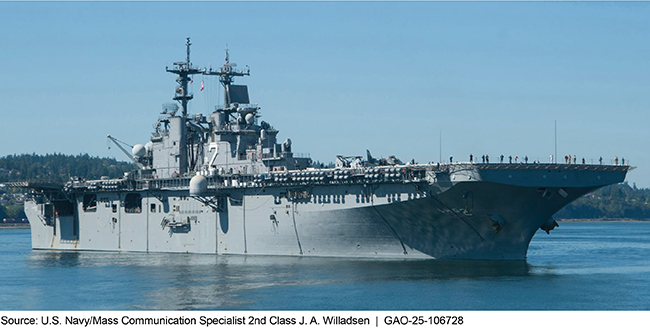
Landing Helicopter Dock (LHD) Amphibious Assault Ship
Highlights
What GAO Found
Amphibious warfare ships are critical for Marine Corps missions, but the Navy has struggled to ensure they are available for operations and training. In some cases, ships in the amphibious fleet have not been available for years at a time. The Navy and Marine Corps are working to agree on a ship availability goal but have yet to complete a metrics-based analysis to support such a goal. Until the Navy completes this analysis, it risks jeopardizing its ability to align amphibious ship schedules with the Marine Corps units that deploy on them.
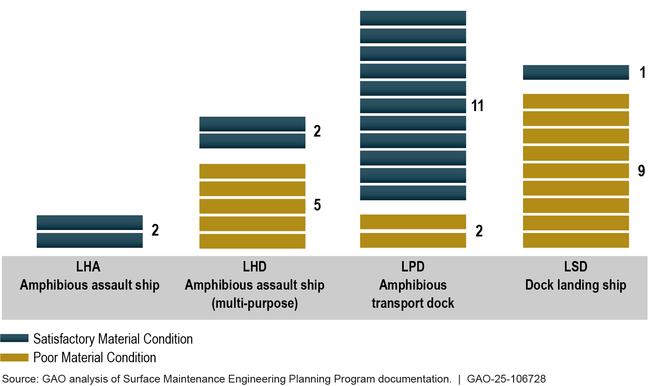
As of March 2024, half of the amphibious fleet is in poor condition and these ships are not on track to meet their expected service lives.
Navy Assessment of the Condition of the Amphibious Warfare Fleet
GAO identified factors that contributed to the fleet's poor condition and reduced its availability for Marine Corps' operations and training. For example, the Navy faces challenges with spare parts, reliability of ship systems, and canceled maintenance. GAO found that the Navy canceled maintenance for aging amphibious ships it planned to divest before completing the required waiver process. Navy officials said they no longer plan to cancel maintenance prior to completing the process, but the Navy has yet to update its maintenance policy to reflect that decision. Updating the policy would help ensure ships the Navy plans to divest do not miss maintenance if Congress restricts funds for divestment.
The Navy is likely to face difficulties meeting a statutory requirement to have at least 31 amphibious ships in the future given the age of many ships and other factors. The Navy is considering extending the service life for some ships to meet the 31-ship requirement. However, these efforts will require up to $1 billion per ship, according to the Navy, with six ships needing service life extensions in the next 3 decades amid rising ship construction costs and maintenance backlogs.
Why GAO Did This Study
The Navy maintains a fleet of large amphibious warfare ships that are used primarily for Marine Corps missions, such as amphibious assault and humanitarian response. There are currently 32 amphibious warfare ships in this fleet, one more than the minimum the Navy is statutorily required to maintain.
House Report 117-397 includes a provision for GAO to review plans for the amphibious warfare fleet. GAO's report examines the extent to which (1) the Navy and Marine Corps are addressing challenges with fleet availability; (2) the Navy is addressing maintenance challenges; and (3) the Navy is positioned to meet its fleet size requirements into the future.
GAO reviewed Navy and Marine Corps documentation and interviewed officials responsible for overseeing fleet availability, maintenance, and new ship acquisition plans. GAO also visited six ships and spoke with officers and crew about maintenance issues.
Recommendations
GAO is making 4 recommendations, including that the Navy use metrics to define amphibious ship availability goals, and updates its policy to clarify that it should not cancel maintenance when divesting ships before completing the waiver process. The Navy concurred with 3 of the 4 recommendations. The Navy partially concurred with updating its policy but noted actions it will take to address the recommendation. GAO maintains that documenting these actions is needed.
Recommendations for Executive Action
| Agency Affected | Recommendation | Status |
|---|---|---|
| Department of the Navy | The Secretary of the Navy, in coordination with the Commandant of the Marine Corps, should refine definitions related to amphibious warfare ship availability to include specific and measurable terms. (Recommendation 1) |
The Navy concurred with this recommendation. In December 2025, the Navy and Marine Corps approved a joint memorandum of understanding outlining expanded ship availability definitions that include specific and measurable terms. This step will help ensure that Navy and Congressional leadership have a clearer understanding of when amphibious warfare ships are available, allowing them to create actionable agreements on what ships are available at what time and in what condition to conduct operations and training.
|
| Department of the Navy | The Secretary of the Navy, in coordination with the Commandant of the Marine Corps, should establish a time frame for completing and implementing their ongoing joint plan to address ship availability concerns and ensure that the analysis results in a specific number of amphibious warfare ships that the Navy and Marine Corps require to be available at any given time. (Recommendation 2) |
The Navy concurred with this recommendation. In July 2026, the Navy provided GAO a memo articulating the Navy's focus on increased readiness and lethality, and that it is pursuing a goal of 80 percent combat surge ready forces by January 1, 2026. The memo outlines combat surge ready definitions and targets for amphibious warfare and other ship classes. It also defines a combat surge ready ship and specifies the number of each class of amphibious warfare ships the Navy expects to be combat surge ready by January 1, 2027. Provided that the Navy continues to use combat surge ready as its readiness criterion, we believe this action meets the intent of our recommendation. Further, it will help provide the Navy with the information it needs to plan ship maintenance and evaluate its performance in completing maintenance on time to meet operational needs.
|
| Department of the Navy | The Secretary of the Navy should ensure that the Chief of Naval Operations updates the Navy's amphibious ship depot maintenance policy to clarify that, absent operational needs, the Navy should not cancel depot maintenance for amphibious ships proposed for divestment that have yet to reach the end of their expected service life, prior to providing the requisite certification to the congressional defense committees and completing the divestment waiver process. (Recommendation 3) |
The Navy partially concurred with this recommendation. In July 2026, the Navy issued guidance and uniform procedures for the consistent implementation of that statute. The guidance notes exceptions to the statute, including safety and other ship modifications that do not fall under the prohibition. It also clarifies that: (1) Maintenance and general repair consist of actions that restore equipment and mechanical or electrical functions to their operational condition. (2) Maintenance and general repair fix or replace components to maintain existing standards. (3) Such repairs made to a platform that do not change or alter the function or performance of the platform are not considered a modification subject to the statute. This guidance will help ensure that the Navy does not cancel maintenance on battle force ships it plans to divest but for which the Congress has not yet authorized expenditure of funding for divestment. This will also help ensure that those ships remain in a condition suitable for deployment to meet operational needs.
|
| Department of the Navy | The Secretary of the Navy should ensure that the Chief of Naval Operations establishes performance goals with tangible, measurable objectives and associated time frames that can be used to measure progress, for implementing the recommendations identified in the May 2023 Amphibious Readiness Review and, when completed, for implementing recommendations resulting from the Navy's April 2024 review. (Recommendation 4) |
The Navy concurred with this recommendation. In November 2024, the Vice Chief of Naval Operations (VCNO) directed Navy commands to assess and take action on recommendations in its Amphibious Ship Maintenance Performance review report, and to provide quarterly updates to the VCNO on the status of those recommendations. In July 2026, the Navy provided GAO with documentation on specific recommendations for which it is undertaking corrective action, along with time frames for completing those actions. Providing these clear performance goals with tangible, measurable objectives will help the Navy address maintenance challenges with its amphibious warfare fleet and improve readiness outcomes.
|