
Indian Health Service: Many Federal Facilities Are in Fair or Poor Condition and Better Data Are Needed on Medical Equipment
Fast Facts
The Indian Health Service's goal is to improve the health of American Indians and Alaska Natives by providing quality and accessible health care services. However, many IHS facilities are not in good condition and IHS's medical equipment is aging—which can negatively affect patient care.
For example, patients' medical conditions can worsen when their care is delayed due to broken equipment. IHS collects information about its medical equipment, but the data is incomplete. Without better data, IHS doesn't know the state of its equipment and can't properly budget for replacement.
Our 3 recommendations to IHS address these issues.
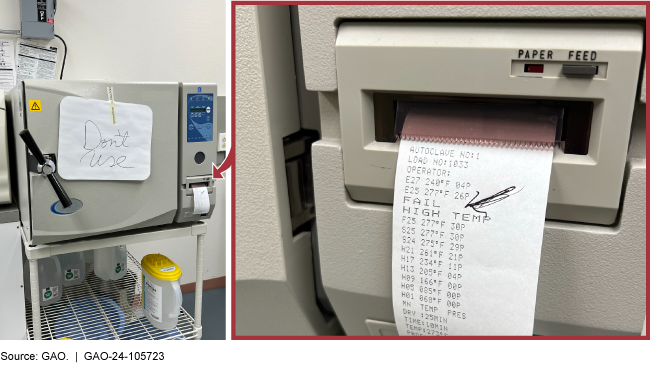
Broken Dental Sterilization Equipment Awaiting Vendor Repair at an Indian Health Service Facility
Highlights
What GAO Found
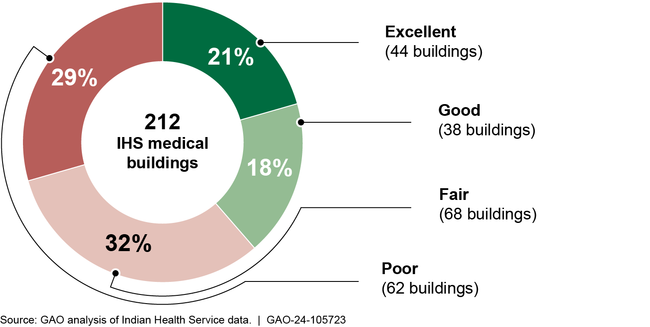
Indian Health Service (IHS) data show that the buildings that comprise its federally operated medical facilities range in age from 1 to 171 years, with a median age of 39 years. Of the 212 buildings that IHS has rated, about 61 percent are in fair or poor condition, compared to the goal of having 90 percent in good or excellent condition. According to IHS officials, older facilities may have insufficient space for modern health care delivery needs and outdated infrastructure that can fail and lead to facility closures. IHS officials also reported that funding constraints and other challenges, such as maintaining adequate staffing levels, limit their ability to repair and improve their medical facilities.
Condition of Indian Health Service Federally Operated Medical Buildings
The state of medical equipment at IHS federally operated facilities cannot be determined because IHS does not have complete or reliable data. Although IHS policy requires its facilities to maintain medical equipment inventories in a designated system, GAO's review of data for three selected IHS areas found that not all facilities were doing so. Further, when equipment was recorded, the data, such as the installation date, were not always accurate. IHS leadership was not aware of these problems until GAO's review and does not know the extent to which similar problems may exist in the other seven IHS areas with federally operated facilities. Without complete or reliable medical equipment data, IHS cannot appropriately plan and budget for its equipment needs, putting its ability to deliver high quality health care at risk.
IHS officials reported using a number of strategies to help mitigate negative effects aging facilities and equipment may have on patient care, including transferring patients to other facilities. Despite these efforts, officials described ways their aging facilities and equipment can negatively affect patient care. For example, overcrowded waiting areas or facility deficiencies like uneven walkways can increase the risk of patient infections or injuries. Also, officials noted that broken medical equipment or having to refer patients to other facilities could lead to delays in care—potentially exacerbating patients' medical conditions.
Why GAO Did This Study
IHS provides health care services directly to American Indian and Alaska Native populations at federally operated medical facilities. Well-functioning facilities and equipment are necessary for the provision of high quality and accessible services.
GAO was asked to review IHS's facilities and equipment and how they affect the provision of health care. This report reviews the state of IHS's federally operated medical facilities and equipment. It also describes IHS efforts to mitigate negative effects on patient care. GAO interviewed IHS officials from headquarters, three geographic areas, and 14 federally operated facilities, conducting site visits to 13 of these facilities. GAO also reviewed agency documents, including relevant policies, and IHS data on its facilities and equipment for the selected areas and facilities.
Recommendations
GAO is making three recommendations to IHS, including that IHS should: assess the extent of medical equipment data problems across IHS areas and implement a plan to correct any problems; and regularly monitor adherence to IHS medical equipment inventory management policy requirements. IHS concurred with all three recommendations.
Recommendations for Executive Action
| Agency Affected | Recommendation | Status |
|---|---|---|
| Indian Health Service | The Director of IHS should assess the extent of the medical equipment data problems across all IHS areas and service units with federally operated facilities and develop and implement a plan to address any problems identified. The plan should include providing resources and guidance, as appropriate, to help ensure areas and service units have complete and reliable medical equipment data. (Recommendation 1) |
IHS officials provided documentation that in October 2023, they assessed some medical equipment data quality issues, such as the extent to which records of equipment included in its equipment inventory management system were missing key information, and created a plan for correction. IHS published a guidance manual in collaboration with IHS Area Offices, based on input on medical equipment data problems. The guidance manual outlines required information and "best practice" details to be included for each medical device entered into the inventory management system. Additionally, the manual outlines the responsibilities of system users to maintain compliant and complete equipment records. As December 2025, IHS officials stated they had confirmed that all IHS Areas and Service Units know that they are required to use Nuvolo as the equipment inventory management system. Officials identified which Service Units were not using Nuvolo as their inventory management system for medical equipment inventory. IHS officials stated they will utilize this list to ensure all federally operated Service Units are using Nuvolo going forward. IHS also stated it is making progress to resolve issues with Service Units which have not used Nuvolo in the past. For example, the IHS Billings Area Office is working directly with all Billings Service Units to confirm and ensure that they are using Nuvolo as required. IHS officials stated they are planning to advertise for a vendor to assist with inventory and data corrections and are also searching for alternatives to ensure that Areas and Service Units have the necessary resources to provide complete and reliable medical equipment data, such as through the use of contractors to work onsite as biomed technicians. However, officials explained that the rural nature of IHS facilities makes this option challenging. We will continue to monitor IHS's progress in implementing this recommendation.
|
| Indian Health Service | The Director of IHS should make the completion of data fields about the useful life or age of its medical equipment mandatory in the agency's inventory management system, consistent with IHS policy. This could include data fields such as "end of life" or "acquisition date." (Recommendation 2) |
On July 12, 2024, IHS officials provided a demonstration of changes made to the agency's medical equipment inventory management system in response to this recommendation. Officials demonstrated that "installation date" and "end of life" are now mandatory fields in the system and that the system was updated to ensure that all mandatory fields are populated before a new asset or edit of an existing asset can be saved. IHS officials stated that IHS entered the missing "installation dates" for 3,383 installed devices, and the missing "end of life" data for 3,702 devices. Overall, officials told us this was a 29.6% and 29.3% data quality improvement, respectively, over a 5-month period.
|
| Indian Health Service | The Director of IHS should ensure that headquarters officials regularly monitor area and services units' adherence to IHS medical equipment inventory management policy requirements. Such monitoring could include regularly reviewing area biomedical equipment governance committee meeting minutes and the agency's medical inventory equipment data to assess its completeness and accuracy. (Recommendation 3) |
IHS issued an update to its medical management policy on March 27, 2024. According to IHS, the updated medical equipment policy reinforces IHS's responsibility to effectively manage medical equipment, track age and function of medical equipment in the inventory management system, develop acquisition plans to replace and purchase new medical equipment, report funding shortfalls, and monitor related activities across the agency. An IHS-issued circular states that IHS will regularly review Area biomedical equipment governance committee meeting minutes and the agency's medical inventory equipment data to assess its completeness and accuracy. According to IHS, as of December 2025, eight of the ten Areas provided certifications and five of the Areas provided equipment governance committee meeting minutes that are required to be submitted for end of fiscal year documentation to Headquarters. In addition, IHS officials stated that the equipment inventory management coordinator has been maintaining status reports on medical equipment. We will continue to monitor IHS's progress in regularly monitoring Area and services units' adherence to IHS medical equipment inventory management policy requirements.
|